

GLAS Spotlights
Atishay Jain
Legal CounselAtishay Jain on Building a Career in Complex Financial Transactions
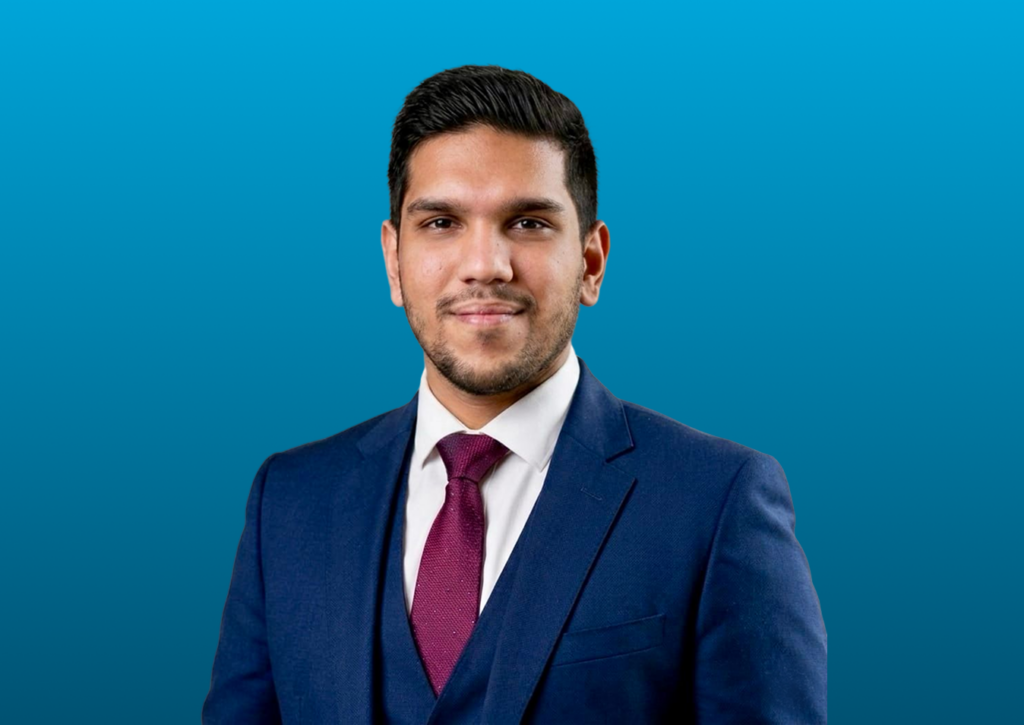
Meet Atishay Jain, Legal Counsel in GLAS’ Frankfurt office. Originally from Delhi, Atishay moved to Frankfurt to pursue his master’s and has since built his career across corporate law, M&A, private equity, and banking and finance. In this interview, he reflects on his journey into law, the skills and perspectives shaped by his work across different markets, and how his role at GLAS brings together legal advice, risk management, cross-border transactions and business-focused problem solving.
Can you tell us a bit about yourself?
AJ: I’m originally from India. I grew up in Delhi and came to Frankfurt around six years ago to pursue my master’s here. Over time, Frankfurt became my home.
Recently, I’ve become a full-time dad and have been blessed with a baby girl, so the last six months have been wonderfully busy in a different way.
I’m also a big sports person, especially cricket, and I love that I’ve been able to carry forward that passion and play here in Frankfurt, which I couldn’t do in the initial years. I play most weekends.
As you might know, a lot of Indians are foodies as well, so I’m a big foodie and love trying new restaurants and cafes with my wife. A lot of time is also spent cooking at home over the weekend.
That’s me in a nutshell.
What has the experience of becoming a father been like while working at GLAS?
AJ: I think it is the most beautiful feeling one could experience. Those tiny hands and feet, and that smile, just make your day.
I know people say you only understand it when you have your own child, but that’s true. I’ve started to understand my parents a lot better, because now I’m in their shoes. It all just makes sense, and having a child really gives you a sense of satisfaction.
I think it has worked out well, thanks to GLAS, my manager and my team in Frankfurt. In the initial months, everyone was very understanding and gave me the time I needed to handle things at home, balance work and look after the baby, and be flexible with hybrid working.
What initially sparked your interest in law, and did you always see yourself pursuing a career in this field?
AJ: It might sound a bit of a cliché, but the series Suits sparked some interest, not knowing at the time that it was all fictional and there was no reality to it.
That’s where the journey started. I wasn’t fully sure if I wanted to pursue law, as I was also inclined towards the business side.
I came across a course at the time that was a dual degree, Bachelor of Business Administration and Law and I pursued that to see where my inclination lay. Over time, I enjoyed law more.
I enjoyed problem-solving and arguments in a good way. I knew quite early on that corporate law was more of my area of interest and not litigation.
Can you walk us through your role as Legal Counsel at GLAS what do you do day to day?
AJ: Here at GLAS, as in-house counsel, I wear many hats, and no two days are identical. My work ranges from corporate matters to regulatory advice, as well as reviewing and negotiating documents, especially syndicated loan documents, which are central to our agency business.
I also support longer-term initiatives that help scale the business. Over the past few months, I’ve been part of an AI initiative and a test group for Copilot. I’m also leading an initiative in Frankfurt to implement an AI legal review tool, where we have been testing different providers.
In addition, I’m the deputy AML officer in the Frankfurt office, so there is a strong compliance and risk focus in my role. in a Nutshell, it’s a mix of corporate work, risk management, and enabling the business.
What types of matters or transactions are you most commonly involved in?
AJ: GLAS acts as facility agent and security agent in the majority of cases, which is our bread-and-butter business. I work heavily on LMA-style documentation, where our core expertise lies.
Alongside these plain vanilla transactions, I’m also involved in adjacent structures such as restructurings, enforcement scenarios, escrow arrangements, noteholder documents, as well as a range of other agency functions.
It’s a mix of new structures and more standard deals that occupies most of my time at GLAS.
Your experience spans corporate law, M&A, private equity, and banking & finance, how have these shaped your current approach?
AJ: I would say the legal field is very dynamic.
There are various sectors, and you are never really an expert in any of these fields. All these different areas of law have given me range and taught me different instincts. For example, M&A teaches you to connect different parts of a deal and piece together the puzzle. Private equity teaches you speed and pragmatism, while banking and finance teaches you the commercial aspect of a deal.
Today, when I face a new transaction at GLAS, I am able to put myself in the shoes of the other person and connect the dots. It really helps me in negotiating with counterparties because I’ve been there before and understand their mindset.
How did your time at firms like AZB & Partners and Deloitte Legal prepare you for your role today?
AJ: These two firms really made me resilient, primarily because one was a law firm while the other was a consulting firm. They really teach you the fundamentals of working. They help you build skills such as drafting, time management, stress management, working to tight timelines, and communicating appropriately in legal language with external and internal stakeholders.
I would recommend anyone early in his or her career to start that journey in one of these firms, because it stays with you throughout your career and prepared me well for my current role at GLAS.
What key lessons did you take from your work in private equity and transaction services at HQ Capital?
AJ: Rather than lessons in transaction services, I would say it really added value for me here in Germany in terms of understanding the working culture, primarily because it was my first role in a German firm, and German companies have a different working style. It helped me understand the market here in Germany.
On the technical side, it strengthened my transaction skills, due diligence and stakeholder management. But the main value was in helping me understand and put a foot in the German market.
From your perspective, what are the most critical legal considerations when structuring complex financial transactions?
AJ: In financial transactions, there are four key things one needs to keep in mind. First is risk allocation: who bears the risk, what type of risk is to be borne, and who is really the decision-maker.
The second is enforceability, whether the structure being derived can really be enforced.
Thirdly, once you have a structure, the decisions and allocated risk, is it operationally viable? What is the operational reality behind the complex financial transaction?
The fourth is whether it is viable from a regulatory perspective or market perspective, whether it complies with all laws, whether all jurisdictional perspectives have been kept in mind, and whether the documents are drafted accordingly. To put it simply, it is risk allocation, enforceability, operational reality, documentation and compliance.
How do you balance providing technically sound legal advice with the need to maintain deal momentum?
AJ: The idea is not to hinder deal flow while keeping GLAS’ position at the forefront. We try to translate legal risk into decision-ready options. We would look at two or three ways to solve a particular problem. You do not really have a trade-off where you are willing to give up on one situation but push back hard on another. It is about balancing the risk and GLAS’ position in a particular deal. This helps deal momentum continue while not compromising the risk, technical or commercial aspects for GLAS.
What factors tend to make a transaction particularly complex from a legal standpoint?
AJ: It is the cross-border element and the complex structure that make a transaction, or our work, complex from a legal standpoint.
Cross-border work adds local law enforceability issues because we might have knowledge of a particular law, let’s say German law or UK law, but when dealing with counterparties located elsewhere, you need expertise or knowledge of that particular jurisdiction.
At the same time, when complex structures are involved, you want to deliver efficiently and effectively. Speed is also added to the complexity. One needs to keep in mind the effectiveness and efficiency of delivering sound legal advice that the counterparty expects GLAS to be good at.
Add all these together and it becomes a complex transaction.
What are the biggest legal challenges you encounter in cross-border transactions, particularly across different regulatory environments?
AJ: Personally, I think it is aligning market standards and regulatory expectations.
Each market has its normal position, so to say, and the challenge is finding a middle ground while protecting the baseline protections, especially those that mostly revolve around liability and role limitations.
We usually stick to acting on the instructions of the lenders or other finance parties, but you must keep certain practical differences in mind when dealing with cross-border transactions. What is standard in one jurisdiction might be unusual in another, and that really affects negotiations and timelines.
Cross-border work is as much about standards as it is about expectations around the law.
Have you seen any notable changes in client expectations or market practice in recent years?
AJ: Yes, especially now that GLAS’ market footprint is ever growing, which is a great sign. Clients expect us to be more transparent and deliver at a faster speed.
Initially, we would deliver our review or complete our review within two to three business days. That has now reduced by 50%, I would say, and we are expected to deliver our review or submit our comments within a day.
The other thing I have noticed is the reliance on ESG and sustainability frameworks, which was not really a focus a few years back. That has now squeezed itself into the regulatory framework.
Finally, the recent AI drive is becoming important. We are also leading initiatives at GLAS with respect to AI, and AI governance is becoming part of the legal and compliance conversation across financial services, especially with the new EU AI Act timelines and transparency requirements coming into effect this year.
What advice would you give to junior lawyers looking to build a career in complex financial transactions and develop strong commercial awareness?
AJ: First, master the basics, including drafting, structuring, understanding how money flows and all counterparties. You can build this through further study, a law firm, or a financial institution with exposure to fast-paced deal work.
Second, build commercial awareness by asking who is paying, what the pricing and timing are, and who is bearing the risk. Legal decisions are influenced by commercial decisions, so both are important.
Third, develop good habits. You need to read a lot, write concisely, and handle pressure.
If you can build these fundamentals, commercial understanding and habits over time, you can really excel in your legal career.







 GLAS
GLAS