

GLAS Spotlights
Mikel Garcia
Transaction ManagerA Journey into Transaction Management at GLAS
A look at the path into transaction management at GLAS, shaped by experience, teamwork, and the day‑to‑day realities of working on complex deals in a fast‑moving environment.
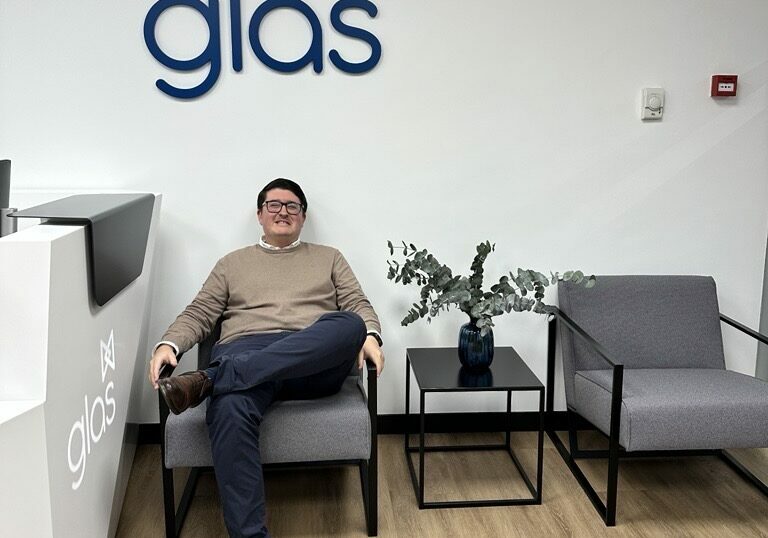
Can you tell me a little bit about yourself?
MG: I’m 29 years old and I was born and raised in San Sebastián, which, in my opinion, is the most beautiful city in Spain. Growing up there shaped a lot of who I am: I really value quality of life, being close to the people I care about, and staying active.
I’m a big sports fan, football, tennis, the NFL, and Formula 1, and my passion for Real Madrid goes way beyond logic. I also love playing padel whenever I get the chance; it’s something that helps me disconnect and keeps me energised.
On a personal level, I’m someone who genuinely enjoys spending time with friends and family. They’re a fundamental part of my life and what keeps me grounded. People sometimes see me as a serious person at first, but once they get to know me, they realise I’m very warm, approachable, and easy‑going.
Overall, I’d describe myself as someone friendly, active, and driven, who values relationships and enjoys being surrounded by good people
You’ve built your career firmly within loan agency and transaction management, what first attracted you to this area?
MG: When I finished my studies, the master’s I did in International Finance gave me an overview of the financial world, and the debt side is one of the areas that stood out to me the most.
When I saw the opportunity to start my previous job at Apex, I was interested because it allowed me to be involved in a broad spectrum of deals from M&A, LBO to Project Finance and Corporate Finance amongst others.
This gave me a 360-degree view of different financial sectors, which was extremely enriching.
Another key aspect was the possibility this sector gave me to build a strong professional network with lawyers, banks, and funds. It also gave me the opportunity to work with traditional banks, direct lenders, debt funds, and different kinds of companies. That ranges from smaller companies, common in Spain due to the market structure, to very large and well‑known companies in Europe, particularly. The possibility to be involved in very different transactions with different kinds of companies was important to me.
How has your prior experience helped prepare you for your current role at GLAS?
MG: I would say it was very important for me because my job at Apex was the first real work experience in the financial world I had.
My experience at Apex Group helped me establish high‑quality standards in my day‑to‑day work. It taught me to be consistent, responsible, and able to work under pressure to meet tight deadlines.
It also helped me understand the Spanish and European market, which made me an important asset. Without that experience, I would not have been able to contribute straight away when I joined GLAS.
Was there a particular moment or transaction early in your career that really shaped how you work today?
MG: To be honest, I don’t remember any particular transaction that changed the way I work.
What I would say is that you learn from both simple and complex deals. Sometimes complex deals are more demanding in terms of detail or financing structure, but in simple deals you can also learn from things like the relationship with the client or what happens during the transaction. It is always helpful.
In my case, I have about five years’ work experience, and it’s more a day-to-day learning process. You need to be eager to learn every day, and that is what shapes the way you work.
What’s it been like joining GLAS and becoming part of the Spain team?
MG: To be honest, amazing.
I joined GLAS in May 2024, shortly after the Spanish office opened, when we were just four: Cristóbal, Daniel, Elena, and me. We are now 10 people in the Spanish office, and I think the relationships we built from the beginning were key.
Joining GLAS has put me at another level in terms of the type of deals I am managing compared to what I did in the past. However, I also feel that there is still a lot more to do here in the Spanish team, which do really inspires us everyday.
One of the main reasons I decided to leave my last job and join GLAS was the opportunity to build something from zero in Spain. That was a challenge, but the reward is pure satisfaction and is turning out to be worth it.
Can you describe your role as a Transaction Manager and what a typical day looks like?
MG: Busy. Really busy.
When I am not dealing with a closing, my day-to-day work involves reviewing emails and managing requests from borrowers and lenders. I may receive compliance certificates or questions that affect the transaction, and I need to manage the flow of information between the parties. I act as the link and need to be proactive.
Being organised is very important. When there is no immediate closing, I still have many small tasks, and if I do not keep track of them, things can get messy. I may have an initial plan for the day, but it often changes.
When several closings overlap, things get significantly tougher. I have my regular day‑to‑day workload on top of the closing process, which is already very demanding on its own. But when multiple closings happen at the same time, the volume of work becomes such that coordination, organisation, and productivity aren’t just helpful, they’re absolutely critical.
How do you ensure technical accuracy while coordinating multiple lenders and stakeholders on complex transactions?
MG: When it comes to managing multiple stakeholders, it is about coordination.
Dealing with a transaction, especially when there are many lenders, the key point is knowing the transaction very well. I need to know all the key points of the deal, how requests work, which provisions require the borrower to deliver information to comply with the loan agreement, which interest period applies, what the margin is, how the margin may change, and whether there are any ESG criteria that could affect the margin.
Doing the work beforehand makes the process more efficient.
What’s been the biggest learning curve since joining GLAS?
MG: The bond side. Before joining GLAS, I had never worked with bonds and now it is part of daily work, as many deals in Italy and Portugal are bond structures. They are bonds with an underlying RCF loan in many cases.
Because of that, I have learned a lot. It is a different sector/product within the market and a very interesting one, but there is still a lot of room for me to grow my knowledge.
I would also say that being involved in meetings with lawyers and potential clients has been another learning curve. I am now more experienced when it comes to attending meetings for business purposes.
You need to be very well prepared, and sometimes you face questions you are not prepared for, so you need to improvise. That comes with experience.
Overall, I would say the biggest learning curve has been the bond side and the business development tasks that I have been involved in with Marina and Daniel.
How does GLAS support professional development from your perspective?
MG: In my case, it comes down to freedom and support from Daniel and Cristóbal.
Since I joined GLAS, they have known that I’m genuinely interested in the business‑development side, not because I’m looking to move from my role as Transaction Manager into Business Development, but simply because I really enjoy engaging with people. They have been very supportive in that respect.
For example, I have attended different events such as Inspiratia in Madrid and in Milan, where I travelled with Cristóbal, Marina, and Daniel. Through this, I have felt very supported.
GLAS has been very clear with me, and I have felt that they have a lot of faith in me and believe in my work. In that sense, I feel fully supported.
I also feel that if in the future I wanted to do a secondment, for example in London or another office, the company would be supportive in that scenario as well. That is very important for me and very different from my previous employer. I am very happy with how GLAS approaches the well being of employees who have different ambitions.
What excites you most about the future of GLAS, particularly in the Spain office?
MG: In general, I would say that the recent news about Oakley Capital entering as a key player will be very important for GLAS’ growth worldwide. That support will help strengthen the teams, bring more people into the group, and make GLAS bigger.
The team we have built is very important. Daniel and Cristóbal, then Elena, Orieta, Marina, myself, and Marta on the TM side, as well as the CS team. The CS team is vital. From the beginning, we really pushed the idea that we needed CS in Spain. We already knew Raquel and Ana from Apex Group, and I am very glad to have the team we have now.
What excites me most is that there is still a lot to be done. And many more revenue opportunities for GLAS to explore.
Are there skills or areas of expertise you’re keen to continue developing?
MG: I would say that one area I want to continue developing is learning more about the work that CS does on a day-to-day basis, just for my knowledge.
Another area is the bond side. There is a lot to learn there.
Another area where I think you can always learn and improve is the relationship with clients. That is basic for growth, both personally and for the office, because it leads to more opportunities and more deals. Having confidence in client relationships and build a strong network is very important.
What advice would you give to someone starting out in transaction management or loan agency?
MG: If you want to build a career in the loan market, you need to be interested in the debt side of finance rather than equity. You also need to be open minded about working on different types of deals and interested in that variety.
You need to be proactive, organised, and comfortable with dealing with people, as well as interested in learning new products every day.
It is important to be calm under pressure. If you are comfortable with pressure, it is a very good area to build a career. You work with many different banks and institutions, and adaptability is key.
The role is demanding, especially during closings, where there is pressure from lawyers and lenders and documents can arrive very late during the night. Therefore, availability is important.
However, whilst it is a demanding role, I believe working at GLAS is an attractive opportunity if you are interested in finance and the debt market.